Pages

Wednesday, July 23, 2014

From the Womb of the Dawn

Part two of a series that started here.

So what's this Psalm 110 all about? Darned if I know, but here goes nothing.
לְדָוִ֗ד מִ֫זְמ֥וֹר
A mizmor of David
So there are a few niggling things that we need to get through first. The first phrase of the chapter, as with many psalms, does not belong to the psalm proper. It tells to whom the song belongs. Does this mean it names the author? Not necessarily, though at times it does seem to do just that. At other times, it could be the name of the collection to which the psalm belongs. Furthermore, the Hebrew phrasing would allow meanings of "for David" as a form of dedication.

Most modern critical interpreters as well as several of the medieval Jewish commentators (Notably Rabbi David Kimchi [רד"ק] and Ibn Ezra) believe the poets of the court wrote this about the Davidic king. On the other hand the Rabbis, the church fathers, and the conservative Christian scholars today believe that the psalm was written by David about someone else.

Of course, in the case of this particular psalm, Jesus himself endorses the idea that it was spoken by David personally. Nonetheless some of the concepts therein are very old, strange, nearly pagan ideas that predate the Davidic kingship. We'll return to this as we examine the content more closely.

Mizmor, by the way, is apparently a musical form of the ancient Israelite court, a type of song, though unfortunately we don't know much more about it at this historical distance. This is a bit of an unusual title. The work looks a lot more like a prophecy than a song, Though it was, no doubt, eventually set to music.
נְאֻ֤ם יְהוָ֨ה לַֽאדֹנִ֗י
The oracle of Yhwh to my lord:
The phrase נאם ה', "the oracle of Yhwh" is used only here in the psalms, though it is found constantly in the prophetic books and is used elsewhere with reference to prophecy. It isn't difficult to envision a prophet standing before his king proclaiming this message on behalf of the deity.

Here commentators divide into three camps. Modern critical scholars, following Kimchi and Ibn Ezra, suggest "my lord" is the Davidic king. The Rabbis (according to Rashi) believed David was referring Abraham as "my lord." Jesus and the Christian tradition believe, obviously, that David is referring to the Messiah as "my lord." Apparently, this seemed plausible to many of the members of Jesus' audience, since, when he said it, nobody asked any questions about it (they didn't dare!).

All of these interpretations have something to be said for them, as we will see. I'll refer to "my lord" as "the king" realizing that this title is applicable both to David and the Messiah.
לַֽאדֹנִ֗י שֵׁ֥ב לִֽימִינִ֑י עַד־אָשִׁ֥ית אֹ֝יְבֶ֗יךָ הֲדֹ֣ם לְרַגְלֶֽיךָ
"Sit at my right hand until I make your enemies a stool for your feet."
To us today (or at least to me), this sounds like an invitation take a load off and put your feet up while Yhwh cleans up the racket. Nothing could be farther from the intention of the prophet. The right hand is a place of action. In many ancient Near Eastern cultures, like medieval European cultures, the king was regarded as the agent of the deity on earth. The king was considered to be privy to the divine council, and often took titles like "Councilor of Asshur," for example. (and hey, remind me never to tell you about my Akkadian teacher's interpretation of "Wonderful, Councilor, Mighty God...")

Suffice it to say, when the king is invited to sit at the right hand of Yhwh, it means he is the primary executor carrying out God's judgment on his enemies. This "footstool" stuff is an image of the king's feet on the necks of his defeated foes, a metaphor for ultimate submission and vulnerability. I still imagine the Messiah sitting in a Lazy Boy next to God's throne with his feet on the ottoman when I read this, but there is actually nothing restful going on here, as we will see in the very next verse.
מַטֵּֽה־עֻזְּךָ֗ יִשְׁלַ֣ח יְ֭הוָה מִצִּיּ֑וֹן רְ֝דֵ֗ה בְּקֶ֣רֶב אֹיְבֶֽיךָ׃
Yhwh will send the rod of your power from Zion -- Rule among your enemies!
The NET effectively translates the first bit as "The Lord extends your dominion from Zion." This is what it means to sit at the right hand of the Yhwh. I feel a sermon coming on about extending the Kingdom of God from Zion to the ends of the Earth, but I guess I'll save it. Suffice it to say that these first two verses provide a lot of useful context for interpreting a whole lot of passages in the New Testament, not least Ephesians 1:20-24... just crazy stuff...
עַמְּךָ֣ נְדָבֹת֮ בְּי֪וֹם חֵ֫ילֶ֥ךָ בְּֽהַדְרֵי־קֹ֭דֶשׁ מֵרֶ֣חֶם מִשְׁחָ֑ר לְ֝ךָ֗ טַ֣ל יַלְדֻתֶֽיךָ׃
Your people will be freewill offerings on the day of your strength in the adornments of holiness from the womb of the dawn. You shall have the dew of your youth.
So now we have problems. Luckily, this is also where it starts to really get interesting. You will note that the English translation makes little sense. The Hebrew makes exactly as much sense. Most English translations here simply note, meaning of the Hebrew uncertain and a few are so bold as to add, "and is likely corrupt." Where to even start with this one?

Leaving aside how messed up this verse is when looking at the Hebrew alone and how many interpretations and explanations have been given over the years, I'm going to skip to the good stuff. If you know how I roll, you may realize that I can only be headed one place: The Septuagint! Woo!
But first, someone tell me what this says:
ילדתיך
If you are anything like every Hebrew speaker I've ever asked, you will immediately say "yalad'tikha." Almost the same thing as the translators of the Septuagint (the Jewish, pre-Christian translation of the Old Testament into Greek) said when they saw this word in the Hebrew text (yelid'tikha; same root, different stem, but functionally similar meaning). In modern Hebrew, in the absence of vowels, there is nothing else you could say. In Biblical Hebrew, you'd be batting nine out of ten with this reading. But no, the Mazorites have read something else here; "yaldutekha," which technically isn't even a word (but could, maybe, theoretically in a parallel universe, appear with such a vocalization since it has a pausal accent).

What's the difference? Well, the first one means "I have given birth to you." The second one means "Your youth" (in the abstract sense, not a synonym for "young people"). This becomes kind of important when adjacent verses are quoted by someone who claims to be the son of God. I mean, sure, we already have God saying he begat the king in Psalm 2:7, but that isn't the Psalm that's quoted over and over in the New Testament.

Anyway, with this word in place, what does the Septuagint have to say here?
Greek Text
μετα σου η αρχη εν ημερα της δυναμεως σου εν ταις λαμπροτησιν των αγιων εκ γαστρος προ εωσφορου εξεγεννησα σε

translation
Nobility is with you in the day of your power. In the brightness of the holy ones, from the womb of the dawn, I have begotten you.
Just to show that this is not wildly off base, here's what the same thing (more or less) might look like in Hebrew:
Reconstructed Hebrew Text
עִמְךָ נְדִבַת בְּיוֹם חֵילֶךָ בְּֽהַדְרֵי־קֹדֶשׁ מֵרֶחֶם מִשְׁחָר יְלִדְתִיךָ׃

translation
Dignity is with you in the day of your power in the adornments of holiness; from the womb of the dawn, I have begotten you.
If any other geeks out there want me to show my work for this reconstruction, I'd be more than happy to do so in the comments. Trying to keep it short for the muggles, but I realize this requires some justification. Let's just say my guiding principle here was to get to a meaning similar to what stands in the Septuagint with as little possible change to the extant Hebrew consonantal texts and ask in the comments if you want to know more. The important thing is, this is only two words shorter than the Hebrew text. Everything else is untouched.

Now, am I saying that this is the original text or pronunciation of the Hebrew? No! It could be, but it also could not be. There are plenty of arguments for either side. Heck, there are arguments for other readings altogether (can I get some love for the Vulgate and a minority of MT manuscripts up in the Holy Hills?). What we can say with one hundred percent certainty is that a lot of Jews were reading this verse this way in Jesus' time, and this is the passage Jesus' quotes twice with regard to his own identity which is picked up elsewhere all over the New Testament. Not to put too fine a point on it, it's the difference between simply saying that the Messiah is David's lord, and saying he is the Son of God.

Of course, having a deity proclaim that he has begotten an ancient Levantine king from the womb of the dawn is pretty much par for the course. In fact, as we'll see in the next post there are plenty of things this king might have in common with his contemporaries. Mechizedek comes to bat for our king, coming soon.

If you like this, please share on social media!

P.S. Sorry this post took so long. I did a ton of research to prepare for it and then realized there was no way I could incorporate all of it into a blog post.

Tuesday, July 1, 2014

Whose Son is the Messiah?

So, I've decided to start this thing off with a series of posts about passages in the Old Testament that are quoted a lot in the New Testament. This will be one of those.

There are some passages in the Bible we never talk about. Okay, that actually goes for most of the Bible, but some of them seem to be really, like, important. Jesus didn't say a whole ton about his own identity, at least in the synoptic gospels (read: first three gospels). Mostly, when people actually know who/what he is, he tells them to stuff it. In fact, I'm not sure Jesus ever gives a completely strait answer about who he really is. Sure, he gives a lot of nods and winks, but nothing too solid in the synoptics (whereas in John, he has quite a lot to say on the subject). The whole messianic thing is kind of a secret up until just before they kill him -- not a coincidence, of course.

So, one of the places where Jesus addresses the question "Who is the Messiah?" is Mark 12:35-37 (and parallels, Matt. 22:41-45, Luke 20:41-44). At this point, his close disciples (and the readers) already know that Jesus has privately affirmed that he is the Messiah, though the other listeners, while they have their suspicions don't know for certain yet.

So Jesus is like:
How say the scribes that Christ is the Son of David? For David himself said by the Holy Ghost,
The Lord [Yhwh] said to my Lord, Sit thou on my right hand, till I make thine enemies thy footstool. (Ps. 110:1)
David therefore himself calleth him Lord; and whence is he then his son?
So how about that? Some scholars think this means Jesus didn't think the Messiah would be descended from David. Not sure that would really make any sense, since it's pretty hard to read the Old Testament any other way. Still, Jesus is definitely undermining the importance of the messianic linage with this statement. Jesus has something much bigger in mind than simply being the heir of David, and we're going to try and figure out what that was. His quotation of Psalm 110 is the key here.

Interesting thing, Psalm 110 wasn't quoted much in Jewish writings much before or after Jesus, with the one exception being the very Jewish New Testament we've inherited. This is one of the most-quoted OT passages in the whole NT. A partial listing would include Matthew 26:64, Acts 2:34-35, I Corinthians 15:25, Ephesians 1:20,22 Colossians 3:1, Hebrews 1:3,13 2:8 5:17 7:17,21 8:1 10:12,13 12:2, 1 Peter 3:22. You'd think it was important or something. Weird we never hear any sermons on it [insert rant about sermons here]. (disclaimer: not picking on my pastor here. I've never heard a sermon about it anywhere in 29 years of church attendance across three continents).

Next post, we dive into Psalm 110.

If you like this, please share on social media!

Edit: Next post is up!

Monday, June 16, 2014

The Sound of Silence

Dear followers and other readers:

I've been away from the blog for quite some time. This is no good. I'm working on finding some ways to make this blog and some of my other works profitable ventures. In light of this goal, there is going to be a lot more content coming very soon. I would be very, very open to comments and questions about what people would like to hear about on the blog. As you may or may not know, my speciality is in Biblical Hebrew, though I've studies Old Testament a bit, as well as the "Historical Jesus"

But I'm game to write about anything Bible related. Recently, I've been doing a Bible study on the Gospel of Luke, and probably have a fair amount to share about anything in the Bible related to gardens, feilds, forests, and the like.

Please leave a comment with any suggestions!

Friday, November 5, 2010

This thing I wrote for another site

http://www.movementandfaith.com/?p=104
Ok, so when I was studying in Belgium, this guy named Stephen did year abroad at my school we went to a really, really crazy party together with the Icelandic prime minister. Craziest night of my life. So Stephen went his way, I went mine a bit later. The Icelandic prime minister went home and shorty thereafter the Icelandic economy fell apart. I don't know, but I like to think that I contributed in my own little way.

Anyway, I came to Jerusalem to study the Hebrew Bible, and he went . . . ok, I have no idea what he's up to, really, but I do know that one thing is that he and his buddies have put together this 'Interfaith' website; something dedicated to finding common ground between various faiths and world-views or something like that. I'm not really sure. I'm not actually sure if I'm totally as excited as they are with what they are trying to do on a philosophical level, but I don't see the harm in it either. The site is http://www.movementandfaith.com/, so you can decide for yourself what you think about what they are doing... though for goodness sake, don't go follow my link and then go and criticize. Stephen is my friend, whatever other kind heretic he may be 8^)

Anyway, Stephen asked me to write something for the site, so I sorta remixed some of the thoughts I voiced here in the last post, took the whole think from a different angle; that is, as a response to postmodernist, rather than a response to fundamentalism, or more accurately, theological totalitarianism.

I think it comes across in the article that I'm quite sympathetic to problems postmodern literary criticism discusses with regard to meaning... maybe more than I should be. Anyway, the whole thing was fun to write. It's a lot more arty-farty than the kind of thing I write on here, generally speaking, so the style is more playful. I think it's pretty good, if I do say so myself, though there are some typos, and I can't edit my article, so they are preserved for posterity. Shoot.

Go comment on it over there!
http://www.movementandfaith.com/?p=104

Saturday, September 25, 2010

Ordo Scientiae: Bible and Theology

I love the Bible. I love everything about it. I enjoy it as literature; I value it as a historical source; I read it devotionally; I take it personally; I believe it is God's word to humankind and chief source of authority in the Church today. I also study the Bible academically, trying to use inductive reasoning to find out as much as I can about the Bible. Like anyone, I am a flawed interpretor. I come to the text with theological and philosophical presuppositions. Furthermore, I am personally involved and bound to whatever meaning I find in the text. However, this weakness is also a becomes a strength, after a fashion. Because I am so personally bound to the text, I think it is important to actually know what it means. Hence: hard work.

I realize that academic study of the Bible is not the be-all end-all in the Christian faith, and there are many things that we discuss in great depth in the discipline to which the devout Christian may, at the end of the day, legitimately respond, "who cares?" I probably see fewer of these cases than some, but they exist. For example, I'm quite linguistically geared. I can, in a passage when the meaning is obvious, obsess for quite a while about why a word is spelled a particular way and not another. I have my reasons that I think these things are important, but they really don't make a difference for any practical point of theology or practice in the Church directly.* Reasons though I may have, it would taste a lie to say I didn't love obscure little points I have the privilege to work out (or at least work on).

However, since the reformation, there has been a place in the church for serious academic study of the Bible. This actually was born out of the Jewish approaches to the Old Testament that were started in the Middle ages, during the Arab enlightenment, and moved westward. The middle eastern Jewish and Muslim scholars started using rational, historical, and linguistically based approaches to the Qurʾan and the Hebrew Bible (for the record, Muslims do not use these kinds of methods any more, though Berkley might change some of that soon, God willing). These were not actually innovations of the Arab world, but rather they were methods used by the Greek scholars at the library of Alexandria for interpreting ancient text which had been more or less lost, and were revived by the Arabs (including Jewish Arabs).

Jews have always said that these kinds of readings, historical readings, are not normative for Judaism, but have rather used them as a basis for inter-faith dialog and polemic, since the historical meaning of the text is theoretically something that can be discovered through investigation. It was used heavily in arguments against Christians and Kara'ites during the middle ages. Though it has never been the basis for Halaka (norms of Jewish behavior, which are far more important than theology in Judaism), it has been used a fair amount in defense of it.

At some point Christians decided this was a pretty clever idea, and some Christians went so far as to suggest that he historical meaning of scripture was the one true meaning. That's a major part of what caused the reformation. I'm not sure whether it's the 'one true meaning,' but really, it's the only way to have a discussion about scripture that places everyone on equal footing. It gives at least a semi-stable way to evaluate meaning. In this manner, it provides a way forward for a discussions between Catholics and Protestants, Jews and Christians, and even to some extent believers and atheists/agnostics.

Of course, atheists and agnostics don't consider themselves bound by the meaning of scripture, but I've had discussions that warm a lot of them up to the Bible quite simply by discussing its content through the lens of reason, admitting the areas where the Bible leaves questions that reason cannot answer, and also showing how the study of the Bible is not just a bunch of nonsense people saying what they want to say about it, but there is are actually some people who are willing to deal with hard data in a way that gives their interpretations a kind of universal accountability.  There is no data that can prove that Jesus is the Son of God and is coming to judge the living and the dead. That is a revelation from the Spirit, and cannot be otherwise.  However, it does give people a glimpse of a form of faith that is able to work with reason and isn't totally arbitrary. It makes sense that, if the Bible is true, we should be able to investigate it. (Obviously all of this is coming from a 'realist' perspective on knowledge. If Nietzsche and Derrida are right, and they could be, then reason doesn't make a difference, but that isn't really a very practical approach, so we keep doing what we can. Even Derrida keeps doing what he can.)

That brings us to the interplay between the Bible and Theology. From my protestant perspective, the Bible is the ultimate source of theology, or at least the ultimate standard. I believe Catholics and Orthodox would also agree with this, though they see tradition as the reliable stream of interpretation. I like tradition a lot, but I see it as more of a servant to biblical interpretation, rather than the master of it. Catholics do things a little differently, as far as I know. I'm a protestant, so all I can explain is why I do what I do. If a Catholic would like to chime in about their approach to scripture, I'd be happy to hear it.

Now, if the Bible is the final standard by which theology is measured, what does theology have to say about the way we read the Bible?

My answer, perhaps somewhat controversially, is 'very little indeed.' I do not say 'nothing,' because we do need a few theological presuppositions to begin reading and interpreting (a metaphysical discussion, and I'm not qualified to lead it). However, if in the course of interpreting scripture, we find something that challenges those theological presuppositions, I think we've got to yield to scripture. Otherwise, we run the risk of getting into a feedback loop where we perpetually hear our own voice in scripture, rather than the voice of God. This goes for any presuppositions, but theological are those that make themselves most felt in the circles where I run. Essentially, if we begin to feel comfortable with the Bible, I doubt we are reading it correctly anymore.

Theology does have an important place in the church (though I think it sometimes overstated), and I'm all in favor of a pragmatic theology to get the job done (the job of the Church, that is), but I think that's really something we ought to check at the door when we come to scripture, if it is really to be authoritative.

Now, having limited the role theology is allowed to play in interpretation, it would be perfectly valid to ask why human forms of reason should have any greater place in interpretation. I agree (in part) with a lot of the recent critiques that reason is simply a human construct, and does not necessarily have any point of reference in reality. So why should we trust it? To that, I give a theological answer (and this is why I say that theology does have a very small part in interpretation): God has made the attempt to speak to humans in human language. If that is the case, there must be some expectation that humans will try to figure out what he's talking about the best they are able, and, in fact, that they must have adequate faculties to do so, even if they are sometimes imperfectly employed.

This presupposition, I think all will agree, is borne out page after page in scripture. If scripture is to be the basis for faith (which I'm not about to try and argue), this, at least, we can count on. The existence of God's verbal communication, in a way, validates the whole enterprise of reason; perhaps not with regard to nature, but at least with regard to the humanities (and maybe nature as well, but we'll have to wait and see about that).

In this way, the very existence of the Bible is an invitation to human reason. Naturally, this does not rule out the joint participation of the Holy Spirit in interpretation. It also does not mean that reason stands above the text. Rather, the reason is simply the proper tool by which to investigate it. The text itself may challenge our presuppositions about reason, and it certainly defines its limits in various places, but it permits its use, along with the Spirit, as the starting place for our inquiry.

That's why I do what I do.
__________________
*They may, however, shed light on the development in the Biblical languages, eventually lead us to understand certain linguistic phenomena better, which may in turn bring us to a new understanding of a difficult or theologically weighty passage. I'm not going to lie, most of what I do at school has no immediate relevance to anyone... but it's a part of the process.

Saturday, September 18, 2010

What's going on here?!

This isn't exactly Biblical studies in this post (nor will it be in the next one). So far, this blog has attempted to stay well within accepted conservative theological perspectives on the Bible because I know that's the perspective from which most of my readers are coming, and there's no need to rock the boat about that if you don't have to. Anyway, I'm relatively conservative when it comes to the New Testament anyway, which is what I've written about, for the most part. Some of the posts on the LXX encroached on shady theological territory, what with the messy textual history of certain books in the OT and all that.

In Old Testament studies, I'm less conservative (relatively, though I try to apply the same methodology to each), and I want to write about them. I've been hesitant because I really am a theological conservative at heart, and I don't want to alienate that group. That's my group. This is part of the reason the posts have pretty much dried up for half a year, though schedule and other factors have also played a role. However, I'm not going to hide anymore just because I have some quasi-liberal ideas about the Old Testament; that is, particularly about the authorship of the Pentateuch and various other issues that will come into play in the next series of posts. I've had enough of that nonsense. If some readers are alienated by that, so be it. "Here I stand, I can do no other."

However, I want to bring the open minded conservatives with me as far as I am able, so I'm going to go slowly and explain why I do what I do, and that starts with a philosophical/theological underpinning for what I'm doing. In these disciplines, I am an amateur, so the more experienced reader will have to bear with me (and by all means correct me) were I err. This is more of a prologue, so more in the next post.

Saturday, February 20, 2010

Since we've been talking about the LXX...

Daniel O. McClellan has written a great post on his blog dealing with some of the issues involved in its translation and transmission. Here's a quote:
In Septuagint studies a common caution against appealing to wildly speculative translator exegesis to account for divergences between MT and LXX is the recognition that the translators were working with a text they recognized as authoritative and unique, and so would have been reluctant to deviate much from the Vorlage. This been confirmed to some degree in a few LXX books where research (particularly of the Finnish school) confirms a high degree of fidelity to the Vorlage combined with dynamic equivalency. In these books, many seeming divergences actually fall within the semantic scope of the Hebrew, if they’re not mistakes or derived from a distinctVorlage.[1] I think caution is in order, though, and I’ll explain why.
Check it out! Reverencing the Text of the Bible

The link was incorrect. fix'd.

Monday, February 15, 2010

Septuagint Pt. 2


This was originally going to be a reply in responses of the previous thread, but it was too long, so it becomes a post.

It is foremost a response to some of Josh's and Hebrew Scholar's objections, but I would like to start out by saying that Helgi's NT professor is a nut. He's part of the Jesus Seminar for goodness sake.
Now that that's off my chest, Lets talk a little more about the Masoretes. It was not their intention, I'll agree, to change anything in the text. They took the best available consonantal texts as the basis for their work. However, they give thousands of alternate vocalizations that would require different consonants. Many of these, it's true, are simple waw – yod shifts, but there are plenty of other differences as well. In other words, their received oral tradition was not the same as the base text. Futhermore, we have clear cases within the development of the Masoretic tradition where the marginal reading (the spoken text) is moved into the main text, and the original consonants disappear. We also have cases of normal scrible errors, mostly with resh and dalet and things like that. Even though the Masoretes display a fidelity that is almost super-human within the scribal world, they were not perfect. Indeed, no two even of the Masoretic manuscripts are identical. There is only one that is in complete agreement with it's own Mazorah (scribal notes), Codex Aleppo, and that text was the work of Aaron ben Asher's lifetime. He spent years correcting and re-correcting it to get it to the state of perfection it is. Granted, the differences are generally negligible, but they do exist. No scribe is perfect.
I agree, of course, that the Hebrew transmission of the text has been much more faithful that the Greek transmission. That is obvious. It doesn't change the fact that there are times when we can tell, due to the nature of the variant, that the translators had a different Hebrew text or tradition of vocalization before them. When there is such evidence, it is not to be taken lightly because it is certainly not an error created by a clumsy or faithless greek scribe who didn't even know Hebrew. The LXX, on many occasions, represents an alternate form of the Hebrew text going back to 250 B.C. (or whenever various books were added). This does not automatically mean that it is the “original Hebrew,” any more than variants found in the Dead Sea Scrolls, Samaritan Pentateuch, or the variants with the the Masoretic tradition itself. It means that, when you find these kinds of differences, you place the reconstructed Hebrew text from LXX next to the MT (and the DSS, if your lucky) and try to work out what happened.
As far as Sinaiticus and Vaticanus, I don't think they are perfect witnesses to the original translations of the LXX. I believe I said they were “fair representations.” The Masoretes were probably the best scribes in history. However, they were not the only erudite school of scribes ever to have arisen. The Alexandrian scribal school was the most renowned of its time, and there were many good Jewish scribes there as well. In fact, Philo of Alexandria believe the LXX translation itself was inspired down to the letter, just as he believed of the Hebrew text. The scribes of Alexandria took the transmission of the LXX very seriously. They did not, of course, approach the level of erudition displayed by the Masoretes, but they were the best of their time. Furthermore, the LXX, contrary to the New Testament, was born in Alexandria. It's transmission in that city was carefully controlled from the time of its creation. I do not mean to suggest that there are no problems with the text. There are. I'm just saying that they its pretty good.
Speaking of the Dead Sea Scrolls, those are definite versions of the Hebrew text that are more ancient than any other, and they often disagree with the MT (and many times agree with the LXX). And don't try to bring arguments about sectarian bias. Most of the Biblical manuscripts at Qumran pre-date the sect itself, and there are very few signs of any sort of sectarian interpolation in those manuscripts. Indeed the very most ancient Biblical texts, those two micro inscriptions found in burial caves at Ketef Hinnom, dated to the seventh century B.C., differ VASTLY from the traditional Hebrew text. They are so early, however, that I question whether the people who made them and used them even thought about any kind of “Bible.” They may just as likely been using something that was repeated with various forms by the priests at the Jerusalem Temple, and were not trying to use a biblical text per-se. That isn't to say that there wasn't some kind of sacred scripture at the time, just that I'm not sure the maker of the scrolls would be any more concerned with it than with the daily rites at the temple.
Aside from those two inscriptions, however, I do think the MT represents the most ancient base texts, older than those at Qumran or reconstructed from the LXX. The Hebrew spelling of the MT is characteristic of the Persian period, as where the spelling at Qumran is from the Hellenistic period. This means that the tradition adopted by the Masoretes reflects an earlier form of consonantal text.
Yes, now is the time to do the double take. The spelling conventions of the MT date to the Persian period. In the first temple period, they only used mater lexiones (consonants that represent vowels... it's complicated...) at the end of words. Assuming there were written Hebrew traditions prior to the first temple period (and assuming that they would have used an alphabetic rather than sylabic scripts), it is doubtful that they would have used any mater lexiones at all (no other alphabetic writing systems of that period do so). In any case, it is nearly inconceivable that whatever traditions we have preserved reflect the spelling of anything prior to the exile. Indeed, the farther back one goes, the less precise it seems scribes cared to be. This is somewhat troubling when it comes to a text with the antiquity of the Hebrew Bible, especially when our earliest manuscripts are many hundreds of years after the original.
Of course, for Josh, I imagine the Torah is of particular concern. We may be very thankful that in all of the various versions, the Torah is the most well established textually. The variants there are not so many or so difficult. The variants in spelling between the DSS and the MT are still everywhere, but the assumed reading is hardly different (indeed, the additional Mater Lexiones in the DSS often confirm a masoretic vocalization that would not be apparent from the consonants of the MT alone). The Torah appears to have been transmitted by all involved with the utmost care as far back as our manuscripts allow us to see (except for some very obvious interpolations by the Samaritans, but even they have been very careful overall). There are still problems, but they are not too bad.

Saturday, February 13, 2010

The Septuagint and Hebrew textual criticism

I'm known among my classmates as someone with a fondness for the Septuagint (the Ancient Greek translation of the the Hebrew bible; LXX for short). The Septuagint is the earliest surviving translation of the Hebrew Bible into any other language.* I have an Orthodox Jewish friend who is quite partial to the traditional Hebrew text, as one might imagine (not that I don't like it). This friend, Josh, is always asking where anyone would get the idea that the LXX is more authoritative that the traditional Hebrew text. Unfortunately, there has never been the adequate time to explain the issues involved, but I do better in writing than talking anyway.
It is to be said from that start, that it very much depends upon what means by “authoritative.” In such a situation, I hardly feel that it's my place to tell to a Jew what is authoritative for his system of belief. Orthodox Judaism holds the Masoretic Text (MT) as the authoritative version of the Bible for their religion (to simplify the story), and I'm not going to argue that they should do anything different (I might argue that they should believe Jesus is the Messiah, but one thing at a time, I guess). 
The question is first and foremost a matter of textual criticism. The problem is that no two biblical manuscripts (prior to the invention of the printing press) say exactly the same thing. Now, in both Old and New Testaments respectively, there is a family of texts to which the vast majority of manuscripts conform, but all of those manuscripts are later than might be desired. In the case of the New Testament, most scholars think that those manuscripts do not best represent the original text, as most of the very earliest manuscripts are somewhat different, and for various reasons, a certain family of ancient manuscripts appear to be the most accurate. Luckly, in the New Testament, we have thousands of manuscripts, many of which are very ancient. Though we can never be sure what the original text was, we have witnesses for most documents quite near to the time of their composition.
For the Hebrew Bible, the traditional text is generally thought to represent the most ancient form of the text. Unfortunately, the earliest of these texts are from the eighth century C.E. The group who produced this text, known as the Masoretes, I would consider to be the greatest scribes who every lived. They took the best Hebrew manuscripts of their time, compared with some of the others, added notes about where vocalization differed from the consonantal texts. They counted words, the counted letters, they counted everything. They invented the system of Hebrew vowels that is still used today (for which first year Hebrew students might hate them). They produced excellent manuscripts, and with an accuracy has never been matched before or after. After doing the world such a great service, they did us almost an equal disservice; the destroyed nearly every Hebrew manuscript prior to their work, locking the Hebrew tradition down to a single family. We don't know what manuscripts they used, and more importantly, we don't know which manuscripts they rejected.
Now, the Masoretes are not wholly to be blamed for this. The Romans, much earlier, had destroyed any documents they found in Hebrew. They also, doubtless, bereft posterity of many Biblical manuscripts, not to mention other interesting documents that would have shed light on second temple Judaism, and probably even earlier times. The Dead Sea Scrolls are, as far as I know, the only substantial Hebrew documents to be preserved from the second temple period. There may be a few others, but they are not so important (or I am very ignorant, which is also possible [remembered later that there has been some good stuff discovered at Masada]). At any rate, they certainly are the oldest biblical texts ever discovered (with the exception of two tiny inscriptions on silver scrolls discovered my one of my teachers a few miles off from where I now sit). Unfortunately, most of the Biblical texts at Qumran are so fragmentary that they are of little use for tracing the history of the text. However, we do have complete witnesses to Isaiah and Habakkuk there, and there are sometimes interesting things to be found in the fragments as well. They are just swell.
However, there are other sources of knowledge about the state of the text in ancient times, and those are the ancient translations. The foremost, as already mentioned, is the Greek, the LXX. The translation of the Torah was in the late third or early second century B.C., and all of the books were probably finished in some kind of fixed form by the middle of the first century B.C., as they appear to have been in wide use throughout the Roman empire by the end of the first century C.E. Naturally, this was a purely Jewish translation, as Jesus wasn't yet born. In the Torah, it is a fairly literal rendering of the Hebrew, and in other books, the style varies, from wooden literalism, to very free idiomatic translation and even paraphrase. The best and some of the earliest manuscripts we have are from the third century C.E., the famous Sinaiticus (א) and Vaticanus (B), produced by the Alexandrian scribal school. Very luckily, this is considered among the best scribal schools of antiquity, and it is also the city where the LXX was originally produced. These manuscripts, though they probably have some corruptions, give a fairly good representation of the original form of the LXX (not that all sections are free from difficulty). Both Jewish and Christian scribes were involved in their transmission, though the Jews had recently rejected the LXX translation, and began sticking more closely to their own Hebrew and Aramaic translations, as well as a new, extremely literal, Greek translation made by one Aquila.
Speaking of Aramaic translations, known as targums, they probably existed orally for a very long time, since the time of Ezra at least, becoming ever more fixed in form, and were written down around the second or third century C.E. Our earliest manuscripts are from the sixth century, as far as I recall. The Targums are fond of paraphrase, and will occasionally add an explanatory note here or there directly into the text. It has also been updated over time to conform more closely to the traditional Jewish interpretation of the Hebrew text. We have much earlier fragmentary targums from Qumran, but they have a lot of differences from the major targums used today, illustrating that this was a somewhat fluid tradition in early times, controlled by the interpretation of the Hebrew.
Though with both the Greek and Aramaic versions, the texts we have are later than one might want, since they are copies of a more ancient translation, they take on a totally different life than the tradition from which they were made. All of the traditions inevitably take on changes as they are passed from hand to hand, but they take on different changes. What this means is that, amongst all of them, we can come closer to what the original version may have been. The more we have, the better.
There are a few other ancient versions of note: The Samaritan Pentateuch. We don't know when the Samaritans first had their distinctive version of the Torah. They claim they have had it since it came from Sinai, and the Jews changed it. However, their text, as far as I know, has more traces of sectarian bias. I haven't done the study myself. It is undoubtedly quite ancient, and should at least be consulted when working on the Hebrew text. The Samaritan communities here in Israel have recently developed a system of vocalization for their text in this past generation. Before that, all of the vowels were transmitted orally. Unfortunately, these texts are very expensive to buy. The first English translation of it with commentary is now at the presses. One of my classmates was involved in the editorial process.
Also to be mentioned are the Latin and Syriac versions, the earliest Christian translations. The Old Latin versions were, unfortunately, based on the Septuagint, and serve us much better to illuminate the history of that text than the Hebrew. The Syriac version his also heavily based on the LXX, but it seems to be conferring with a Hebrew text as well. It must be used very carefully. The later Latin Version, the first commissioned by the church, is Jerome's Vulgate from the end of the fourth century, a translation directly from the Hebrew. It is, overall, a good translation. It appears to represent a Hebrew tradition very closely related to the the traditional version still used in Synagogues today (which makes the divergences even more interesting).
Now, when dealing with all of this evidence there are several things to take into consideration. The translations are very interesting in and of themselves, as they very much represent the theologies and interpretations of the communities that created them (this, perhaps, is where my love for the LXX is really founded. It shows us how Jews were reading the Bible in pre-Christian times). However, if one is simply inquiring as to history of the Hebrew text, One must be very careful how they evaluate the evidence. There are many cases of explanatory words and phrases being added by the translators, and one must be aware of such things. In additions, there can be changes which are clearly scribal errors in the receiving languages. What is most interesting are cases that reveal scribal changes and errors in the Hebrew.
There are cases where the Masoretic text (MT) is very difficult to understand, and the LXX says something totally different. When this happens, one attempts to reconstruct the Hebrew underlying LXX. Sometimes, is seems clear that the translators simply changed the meaning so it would make sense, or a Hebrew scribe added a word (a much more rare occurrence). Other times, you will find that it is the difference of a single Hebrew letter, and when that is amended, the MT makes perfect sense. These are the kinds of the things the textual critic is looking for. There are even times when you find that the meaning is totally different, but the reconstructed Hebrew text is identical. It is only the Vowels that are different. This is even more interesting, since the vowels were only written down in the time of the Masoretes. However, occasionally, the LXX, Targum, or the Latin version will attests a different tradition of vocalization. It is often up to the textual critic to decide which of these vocalizations makes more sense in context, and there are few objective criteria to be used (aside from conventions of Biblical Hebrew orthography, which themselves are hotly debated).
However, I must impress that, overall, there is great unity among the various textual traditions, and the stand as a testament to the good work of the Masoretes and their predecessors. There are some exceptions. Jeremiah and Samuel are huge problems textually. The Psalms are also not great. Still, the messages of these books are not greatly changed by such problems.
This further raises questions about which form of text any particular community should be exegeting. To that, I don't have an answer. Catholics have the Latin versions and the Canons for interpretation, Eastern Orthodox have the Byzantine text of the LXX. Orthodox Jews have the MT and the Midrashim as a source of authority. As protestants, we say that we are trying to reconstruct the original text. However, most of the books of the Old Testament (in contrast to those of the New), went through extremely long periods of editorial process, and it is difficult to say which text is then the “original.” In some books, it seems there are textual witnesses from before the completion of a large part of the editorial work (such as Jeremiah). On the other hand, even the MT represents, in a way, a final phase of editorial and interpretative decisions (as do all translations, ancient and modern). As a student of scripture, this is a fascinating process. As a Christian who goes to scripture as a source of authority, I must admit it causes some perplexity, and leaves me in search of paradigms for inspiration and authority that do justice to the complexity of the text we have. That question, I must leave for others until a later time. I certainly don't have an answer at the moment, and theology isn't exactly my strong suit. Reading the Bible tends to mess up one's theology.


*With the possible exception of some fragmentary Aramaic versions from Qumran, which may be contemporary.


P.S. Having recently read some things by Prof. Emmanuel Tov, this post seems so yucky and inadequate. I really need to look more into OT textual criticism. 8^(

Wednesday, January 13, 2010

Anyway, about that blog list...

That list I got on to two posts back... they decided to stop doing it.

I'm not on any list anymore, particularly not right next to Ben Witherington III. Oh well. *sigh*

Friday, January 1, 2010

Synoptic Gospels: My Theory...

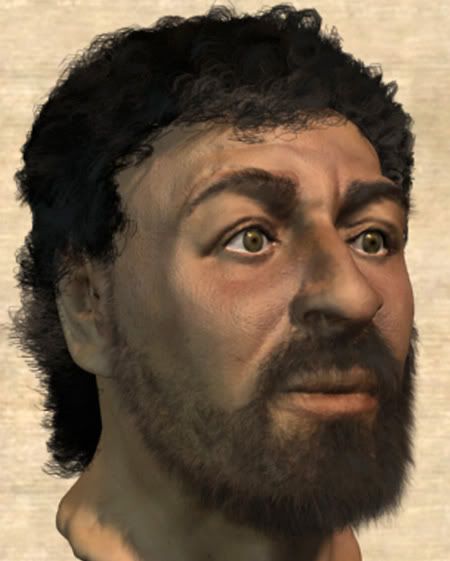
That weird BBC reconstruction of Jesus' head.

The in post before the last, I talked a bit about oral tradition, Hebrew Matthew as an early collection of this oral tradition, and the development of Greek oral tradition as the Gospel moved into new contexts. Mark would then represent a written form of this phenomenon. This was not just any tradition, but, if the father's are to be believed, it was selections from the preaching of Peter masterfully arranged into a complete narrative, a document quite unlike Hebrew Matthew, which, I suggest, was a collections of sayings arranged topically, perhaps occasionally placed in a narrative context.

Now, the publication of Mark's Gospel would have had a great effect on the Greek Oral tradition, causing it to become much more stable in the communities where it was promulgated. Still, Mark's Greek isn't particularly good, it seems that native speakers often felt a need to correct him in the retelling of the same traditions, not to mention that independent oral traditions in Greek must have already existed, and probably also had an influence on the retelling of Mark. I'll get into evidence of this in a few paragraphs here. Let's get on to my favorite gospel now, Luke.

I like Luke because he approached the writing of his Gospel in the same way that I would have. He got as much evidence in front as he could, and tries to present it as accurately as possible. He seems to be a product of Hellenistic culture, and therefore shares many of the concerns that other western historiographers might. That's not to say he doesn't have an ideological agenda. It is to say that all historiographers have agendas. However, Western historiographers operate under the assumption that their argument will have the most force if it is grounded in verifiable facts. It appears to me, and to most others, that Luke knew the Gospel of Mark in some form, and possibly knew the man, John Mark, as well, if the traditional ascriptions of authorship are true. Luke follows Mark's chronology very closely (up until the passion narrative, where he prefers a different order) but he polishes up Mark's Greek.

Furthermore, it appears that he also had a Hebrew or Aramaic source in front of him, because he's often translating it very literally, and we can see the semitic syntax, especially in the sayings. Let's go ahead and call that Hebrew Matthew. But Luke was probably working with other semitic sources as well. One of those sources, again following the traditional view on authorship, would have been Paul, and whatever strain of Hebrew/Aramaic oral tradition was current in Pauline circles. From the first couple verses of Luke, it also seems very possible that he sought out eyewitnesses and used them as another source. He has no qualms about going against Mark's report when he believes he's got a better tradition, and he prefers almost always to make his own literal translations of semitic sources. It is also important to note that he did not attempt to fully preserve any of his sources, but to use all of them to create the narrative he wanted to create. Because Luke was came out a bit later and didn't follow any previous form of the Greek oral tradition, Mark continued to be more often quote for its familiarity, though sometimes in a polished form. Luke's main influence on the oral tradition was in the areas where Mark had not written, and this was still not so profound.

Some time later after the Greek oral tradition had really begun to crystallize, some anonymous saint came along and decided it would be worthwhile to preserve Hebrew Matthew in Greek (for which I am very grateful, being that it is lost in the original, unless there are bits of it preserved in Shem Tob's Hebrew edition of Matthew, a topic I'm not going to touch now). However, this wasn't all he did. He retained the structure of Hebrew Matthew for the sayings, but supplemented by Mark's narrative in polished Greek. In the sayings, he likes to follow Mark very closely where he can, sometimes fixing the Greek according the oral tradition. In other places, he follows, I think, different forms of the Greek oral tradition, which is sometimes influenced by Luke's translations of the content of Hebrew Matthew (and thence the so-called Q), and sometimes takes another form. Occasionally, he makes his own original translations, which, like Luke's, tend to be quite literal. It appears that this writer believed the Greek oral tradition to be authoritative, which is consistent with what we know of the early second-century fathers.

Because Matthew relied so heavily on the established Greek oral tradition for its wording, it was immediately popular in the church for its familiar sound, and quickly became the most quoted gospel (though I must admit, it may have gone the other way around, and it only seems that Matthew is quoted so often because he used the authoritative Greek oral tradition. It probably worked both ways, in reality), and was naturally placed first when it came time to order the Canon. Even today, The sayings of Jesus are most often recalled according to the Greek version of Matthew.

So finally, we are left today with Mark, a crude translation of Peter's version of the oral tradition, masterfully arranged into a thrilling historical narrative of a very eastern kind, Luke, the "historical-critical" Gospel, and Matthew, our only glimpse of Hebrew Matthew, and the preservation of the Greek oral tradition promulgated in early second century church. Course, we also have John, but that's something else. I don't even know where to begin with John.

(For those who want to know, I think the Western textual tradition of the gospels also preserves a lot of elements of the Greek oral tradition that are not found in the canonical Gospels. If this could be proven, their value in study of the historical Jesus would go up tremendously. Unfortunately, I don't have time to do this myself, working on an MA in OT at the moment. Perhaps one of you working on a graduate degree in New Testament could make a good project out of the Western text, seeing where it represents scribal corruptions of the original, and where it appears to represent a separate oral tradition. This topic could easily be a doctoral dissertation.)

Thursday, December 31, 2009

NO!! I'M IN THE BLOGOSPHERE!!


Hey everyone, I've been drowning in work here, but I love it. My teachers are excellent, and my classes interesting (at the Hebrew U of Jerusalem, for those who don't know). Whenever I get a free moment, I will have TONS of stuff to blog about, Old Testament style.

I hope to squeeze out another post about the Synoptics tomorrow, if I can muster the energy for it, and finish up the whole thing about the Gospels by the end of January, so I can shift my focus to what I'm working on now.

Despite the lack of attention I've been giving this blog, it appears to be gaining a flourishing readership. Just found out that I've been listed on Biblioblog Top 50 Website. I'm at 122 right now, for the month of December. Interesting, since I've barely posted anything in the last couple of months. I'm listed in the complete listing under New Testament and Early Christianity, right next to Ben Witherington. Hmm... I feel good about this, and I'm not sure that's a good thing.
Who cares? maybe me a little, but I guess not the readers of my blog. More on the Gospels tomorrow.

Saturday, November 14, 2009

Synoptic Solutions: Oral Tradition

Ok, The reason I started this blog in the first place was actually to get my theory on the compositions Synoptic Gospels out there, but I wanted to spend some time getting a few readers, make the posts a bit episodic so I didn't just drop the whole theory on you all at once, the theory I came up with shortly after finishing my BDiv. A year and a half ago.

Let's make a quick review:

June 7, 2009. I state my difficulties with the typical Q hypothesis; ie: no external evidence exists, but I go on to hint at another kind of Q, Hebrew Matthew.

June 15. I provide a small list of references to Hebrew Matthew found in the Church Fathers, The most interesting being the earliest, Papias, who says that Matthew published the sayings of the Lord in the language of the Hebrews, and that each interpreted them as they were able.

Oct. 9. I explain what kind of a document I think Hebrew Matthew was: similar to other rabbinic collections; the collected wisdom of a great teacher containing mostly sayings, occasionally with bits of narrative material to situate the sayings. In this case, I believe the the material was arranged topically in five sections, those we see reflected in our canonical gospel of Matthew. Of course, this is very tentative, and much more work must be done on the relevant texts before more can be said (and really, this is already too much).

So, let's begin to paint the historical portrait:

Jesus teaches his disciples and the crowds. This is the beginning of what we call the oral tradition. In an Eastern context, a great teacher teaches and says many of the same things over and over again, and people memorize it. Of course, his close followers will get the inside scoop on his total world-view simply by being with him, seeing how he lives and how he thinks. In all of the Synoptic gospel account we have Jesus, at one point or another (or more than once), sending out disciples to proclaim his message. We must assume that the core of Jesus' early message had begun to crystallize into distinct oral forms within his lifetime if he was already sending out his followers to preach it. This oral tradition must have been in Hebrew or Aramaic or both.*

Certainly shortly after his death, oral forms of the sayings would have been quite fixed. This represents the earliest forms of the sayings material in the Gospels. In the transmission of such material in an Eastern culture, there are also sometimes narratives, but the narrative material is not as closely controlled by the community as the sayings. This may be a partial explanation to why he have such close affinities in all the sayings material, and less continuity in the Gospel narratives (though they are obviously also in close relation).

I think Hebrew Matthew must have contained a direct record of these original sayings, probably composed in Hebrew, rather than Aramaic, if my intuition is correct. I don't want to make any bones about it at this point in my research, however (not to mention that my personal grasp of Aramaic is still in its infancy).

After the dispersion of the Apostles, at the beginning of the spread of the Gospels in the wider Roman world, the early preachers and teachers necessarily began to translate Jesus' teachings into Greek. The Greek oral tradition would necessarily be more free in early stages, but would still be controlled by the rigid underlying semitic tradition. Still, different forms of the sayings would have developed in different regions. There's more than one way to translate anything. That's just how it is.

Mark is probably our earliest example of this. I will accept the testimony of the early Church that Mark is a collected narrative based on Peter's preaching until I find a good reason not to do so. He probably wrote around the time of Peter's death in 64 AD, but who really knows? However, Mark is much more than a mere translation and recording of the primitive oral tradition. It contains eyewitness narratives. In addition, the arrangement of the material is a unique work of art, creating a narrative super-structure that is at once both cryptic and enticing. I can't get too heavily into this discussion, as I'm still something of a neophyte (aka: n00b) in Markan studies.

However, what I will say is that the publication of a Gospel in Greek must have had a tremendous impact on the stabilization of the Greek Oral tradition.

That's all I'm saying for now. Next post will deal with my theory on the composition of Luke and Matthew.


* Note concerning language: According both to the Mishnah and Josephus, all Jewish boys learned to read speak some level of Hebrew from the age of six onward. It is often said that Hebrew was the language of literature and religious discourse, and Aramaic was the everyday spoken dialect. Well, I'm not sure about that. At Qumran they were writing religious texts in Aramaic as well as Hebrew, and Josephus transliterates some direct speech of the soldiers during his defense of a Galilean outpost, and the soldiers are speaking Hebrew. Some have suggested that Hebrew was still a colloquial language in Galilee, but Aramaic was the language of the street in Judea. I honestly have no idea what language Jesus was teaching in, but probably a bit of both. He certainly would have been able to speak both, and it is not uncommon to find that rabbinic and Qumran texts are very much a sort of hybrid between the two.

In any case, the two languages are not very different, and it is not overly important. Most of the saying can be reconstructed into Hebrew or Aramaic with equal ease, as the syntax of Palestinian Hebrew and Aramaic had almost completely merged by that time, with only a few unique uses of the ancient Hebrew tense system being used for literary effect in an artificial way (very much as you still find some people praying in botched King James English today). The vocabulary in Aramaic and Hebrew is also quite similar, and the primary difference between using one language or the other (at least in Rabbinic writings) was changing some endings, using different roots for a few common words, and putting the article in front or behind the word. It's a bit like the difference between Danish and Swedish, as far as I can reckon (by contrast, pre-exilic Hebrew differs much more from Official Aramaic, the dialect of the Persian Empire)

It is also very possible that Jesus spoke Greek at times to gentiles, though he may have also spoken Aramaic to them. Difficult to say, really.

Friday, November 13, 2009

Gender Wars!!

In the comments on the last post (perhaps inevitably) the issue of gender language was raised, first by myself in passing, and again by somebody else. I think this problem is probably felt more sharply in English translation than in many other languages, because we have no grammatical gender, but only designate in pronouns according to natural gender (compare with el and la of Spanish, le and la of French, or der, die, and das of German; hopefully all of us Americans can relate to something in that list). In any case, the situation in Greek and Hebrew is different than English. In most languages, if you want to designate a mixed group of natural gender, it is normal to use a masculine plural (ie: los amigos/die Freunde = friends who may be male and female).

In English, however, we only have gender for people and certain animals, and it all lines up anatomically. This is very pleasant for the foreigner who wants to learn English, and quite problematic for the Bible translator, and has created a huge controversy in recent years. In the past, we could also use 'men' for 'people,' but the feminists have changed all that. It seems the feminist are also at work in other languages, and this begins to be a problem elsewhere as well. At least I am happy to report that it is not possible to translate the Bible in a way that will make it complementary to the feminist agenda. It still says that there are differences between men and women.

With these things in mind, I would say that I am generally in favor of these so called 'gender-neutral' translations, in as far as they are faithful to the original languages, which doesn't seem to be a issue in most of them. Anthrōpos (Gk. -person/man) is a fairly gender neutral word, and I think that's how it should be translated in most cases (same goes for adam [Hb. -human/man] and bnē adam [humankind]). Adelphos (Gk. -Brother) has to be translated according to context, I guess, since it could really be either. Same with enashīm (Hb. -men/people), and sometimes īsh [man/person] (Though īsh is usually better to translate as masculine except in some generic cases).

There are words in Hebrew and Greek to designate specifically groups of men, andres and gbarīm, as well as groups of women, gynaikes and nashīm. The very fact that words like this exist illustrate that native speakers did not feel the more general terms expressed biological gender adequately, and the translator needs to be sensitive to that.

At the same time, we must realize that in the ancient world (and today in the east), one would rarely address someone of another gender outside of their family. Gender roles were very clearly defined, and this is something that the exegete and faithful translator must come to terms with, no matter how strange it seems today. But, we still cannot leave it even at that, especially in the New Testament, where some cultural gender roles are clearly subverted, others appear to be upheld, and others are of little direct concern to the authors.

It's not as cut and dry as either side would like to make it. I think those who insist on rigidly translating masculine grammatical forms as masculine are clearly in error in many cases. However, to eliminate antiquated cultural gender distinctions is also a mistake. The Bible is a product of the ancient world, but it also challenges that world.

This is yet another case were a good translator must first be a good philologist, anthropologist, and exegete.

In fact, I think translation must always be guided by exegesis. It's not a sure path to correct understanding, but it's got to be better than translating each verse or clause in an atomistic way. I think this realization is the greatest advance in modern translations over older ones, but we still have a long way to go before it's fully implemented (though I will say that the translators of the NET Bible are quite astute in this area, and those of TNIV, NRSV, and NJPS have also made some good progress).


Anyway, I think next week I should really get back to writing about the Synoptic problem. Translation is BORING!

Friday, November 6, 2009

Translations


As someone with a degree of proficiency in Biblical languages (by no means an expert), I sometimes get asked about which English translations I would most recommend. This is kind of a funny question for several reasons. The first being that the moment you acquire enough skill in biblical languages that you could seriously evaluate the translations, the question of 'which translation?' itself becomes much less meaningful. When I read through the First John in Greek, my collection of bible translations stopped growing. The other thing that immediately comes to mind is exactly how much pain it causes to recommend a translation when you know that they are all fail to communicate in so many ways the riches of the original. For this, I must refer you to my disclaimer in the post below.

Putting aside the fact that all Bible translations are horrible, desolating abominations of corruption against the original sacred text, allow me to recommend a few. I'm only discussing those which I have used a fair amount.

First of all, let's just get the best one out there on the table. If you really want to get in touch with the original text without actually studying Greek and Hebrew, the best thing you can get, hands down, is the New English Translation (NET Bible). The translation is very good and original, and furthermore has a vast number of notes about the translation and original languages (over 60,000). Notes are really the only way get close to the original text. They've been working on it for years, and it's constantly being subject to peer review and improved. You can get it in print, for Kindle, for various Bible programs, and you can study it online. If you can't use the original languages, this is an indispensable tool (and it still helps even if you know them). You can also get text only editions that don't include the notes. The translation itself is very good. Similar style to the NIV, but a bit more modern, and much better decisions. However, the notes are what make this THE bible to have among all what's out there. I have it on my computer, and I am remorselessly lusting after a print edition.

As for other translations, there are a couple to be careful with. Aside from the obvious, like the New World Translation (the Jehovah's Witness translation), there are some very popular bibles out there that have major problems. Let's start: The Message. It's not a translation. It's hardly even a paraphrase. It's a commentary. There are whole sentences that are not based on anything in the original text, but are instead explanations of the author. As a commentary, it's not very detailed, but it is very readable, and there is good stuff there. I would recommend this only if one views it as devotional literature. It is one man's reflections on the Biblical text. It's not bad, but it's not a Bible. The Living Bible also falls into this camp, though it is not quite as free as the The Message.

Next, on the absolute opposite side of the spectrum, the American Standard Version (ASV). This is an extremely literal translation from the end of the 19th century that gave many people a lot of funny ideas and ended up starting a bunch of cults. It's not bad in itself, and is nice if you know biblical languages, but it isn't much use in actually discovering the meaning of the text. The modern descended of this translation is the New American Standard Bible (NASB). It's been edited to provide better English syntax, and to avoid the the heresies that some people read into the ASV. However, the NASB fails on several counts. It sometimes is so literal that obscures meanings that are clear in the original. When decisions about the meaning of the text have to be made, it seems that the interpretation is based upon whichever understanding allows preservation of the original syntax, and it almost never takes into account the argument of the books as a whole. Sometimes it translates quite brilliantly, but other times there are serious problems. I must question it's value in giving a genuine understanding of the text. Furthermore, it's a bit weak in terms of textual decisions. There are good literal translations (which I will get to), but ASV and NASB are not among them. You might want to have an NASB on your shelf for comparison, but you have to know where it's weak. It's kinda like Google Translator. Google might be better.

NIV and New Living Translation (NLT) are somewhere in the middle. decent, but not great. There are much better translations out there. NIV has nice English style, but the translators of the Old Testament don't seem to have been awake at their work. There is a lot of rubbish in the Old Testament. The New Testament is better, and there seems to be some kind of logic in their interpretative decisions but it seems to be more in order to support traditional interpretation rather than to make sense of the argument of the author. They also follow the vocabulary of the King James a lot where the meaning has changed drastically. The New Living Translation is similar, but they do make some nice modern translations, and at least the style is excellent for just sitting down and reading. The main problem in this one is over interpretation. Sometimes they make the meaning much more precise and "clear" where the original is somewhat cryptic or vague. Not totally a bad thing, but you have to realize that this is what's being done.

Next, let's get to the good literal translations. You can't talk about good literal translations without mentioning the King James. It sets the bar, and it sets it high. KJV is undoubtedly the most beautiful English translation ever produced. It generally preserves ambiguity where the original is ambiguous, and it is not afraid to bend English syntax here and there when it can be done. The Translators worked long and hard, going through multiple levels of peer review, and the result is a monument of Anglican scholarship. There are some problems, however. English has changed a great deal. Words mean different things now. I'm not just talking about 'thee' and 'thou.' I'm talking about 'rest' and 'conscience' and 'justification.' We think we understand these words, so much that the modern translators usually continue to use the same, but they meant something different 400 years ago. The King James translators were very right to use them where they did, and the modern translators are very wrong. In addition, there are places were our understanding of this or that Hebrew idiom (including those found in the New Testament) have improved over the years, as has the approach to translation. It is occasionally hard to follow the authors train of thought in the King James. Finally, perhaps the greatest problem is that we have discovered Greek manuscripts of the New Testament that are much older and generally believe to be more reliable than those available to the the KJV translators. My Greek teacher always would say that it was an excellent translation of bad manuscripts. However, the Old Testament is still useful, as is the New when compared with modern translations and a good dictionary may be helpful for getting at those antiquated meanings. I don't particularly recommend the NKJV, by the way, as it basically just diminishes the beauty of the King James without really addressing the weaknesses of the translation.

The other good literal translations are revisions of the King James (in fact... I think most of the bad ones are too). I can speak about three of them: Revised Standard Version (RSV), New Revised Standard Version (NRSV), and English Standard Version (ESV); The latter two being revisions of the first. The ESV being branded as "Conservative," and the NRSV being labled "Liberal." It would be more correct to say that ESV is traditional and NRSV is academic. First off, None of these are quite as literal as the KJV, NASB, or NKJV, but they still follow the original languages quite closely and often also preserve the vocabulary of the King James (unfortunately, in some cases). The RSV is from the 50's, and I think it is the most beautiful translation into modern English. I haven't used it so much, so I'm not in a place to comment on it's strengths and weaknesses further. The ESV very nice in terms of style. It's literal, but it reads smoothly, and preserves the traditional interpretations very well. I have also notices that this is one of the best at avoiding the temptation to over-translate something. If they original is cryptic, they translate it as cryptic in English. The NRSV is also excellent. I prefer it to the ESV because it's interpretative decisions are based more on a thorough understanding of the text as a whole, as opposed to a rewording of traditional interpretation (which is what most of the modern translations amount to). This is also the one of two translation in English that I'm aware of that takes the science of Old Testament textual Criticism seriously (the other is the NET Bible, mentioned above). I can't go into what that means right now, but believe me that it is one of the best if not the best translation of the Old Testament out there. The New Testament is also great. The NRSV is the standard in the academic world as well. The NRSV is also an Ecumenical work, with scholars from all branches of the church including Roman Catholic, Orthodox, Mainline Protestant, Evangelical, Pentecostal, and so forth. They even had a Jewish guy working on the Old Testament. It has been approved for use by more denominations than any other. Evangelicals don't like it because it says "young woman" instead of "virgin" in Isaiah 7. To that, I say who cares?

One literal translation that I haven't checked out too much yet is the NAB, New American Bible. It's Catholic, and I hear that it's very good, but it does suffer slightly from the fact that it necessarily must uphold Catholic doctrine. Still need to get my hands on this one and see how it is.

Finally there are the idiomatic translations that I like; TNIV (revision of the NIV), HCSB (Holman Christian Standard Bible), and New JPS (Jewish Publication Society). The TNIV is what I generally use for my devotions. It is awesome. Very similar to the NIV, but improves upon all the weaknesses. Tends not to over-translate as much. Makes decisions in light of the argument of the book, and re-evaluates the value of traditional vocabulary at certain key points. Great. There are still a few dodgy bits in the Old Testament, but it's a lot better. HCSB is a Baptist translation. It likes Baptist doctrine. I realize this sounds awful, but it's not. They have made good use of their lexicons and come out with some brilliant translations. Not as strong as the TNIV, but very useful for comparison. It's actually also quite literal, come to think of it, but it still feels smooth and modern to read. Good translation there. Occasionally some senseless interpretive decisions, but what the heck, they're Baptists. The New JPS is a Jewish Translation. As you might guess, it's only the Old Testament. It gives a very good sense of the Hebrew in very readable English. It competes with NRSV and NET as best translation Old Testament, though it sticks to the traditional Jewish text, and doesn't touch textual criticism. Of course, they do their best to translate in such a way that would obscure the Messiahship of Jesus, but it's still pretty obvious if you ask me.

In summery, the best translation by far for study of the text is the NET Bible. Other favorites translations are NRSV, TNIV, JPS. I also like KJV and ESV because they are quite beautiful, though they have problems (the modern reader will probably get more millage out of the ESV, by the way).

Of course, nothing beats the originals in terms of beauty and clarity... (but the notes in the NET Bible still rock...)

Translations Disclaimer!!


I'm in an Old Testament class here were someone asked the professor, Dr. Baruch Schwartz, which translation he recommended for those not using Hebrew. He recommended the JPS, a modern Jewish translation that has a similar translation philosophy to the NIV, but almost always gives much better renderings of the Hebrew text, and of course, slants the translation in a way that is more harmonious with Jewish belief. He also mentioned that, in the class, he would like to get as many different translations as possible. Another student wanted to clarify and said, “So, the JPS is a good translation?” to which the professor replied, “No, it's terrible. They're all terrible. You can't capture the richness of the Hebrew in any language except Hebrew. If you need a translation, just bring whatever is the easiest for you to understand, and we'll discuss the text in class.” It's like the old saying, “There is no error in translation. Translation itself is an error.”

But, this is just how we talk in the Academy. If everyone read Hebrew and Greek, that would be wonderful, and we wouldn't have to walk around with these rubbish translations. In fact, I'd recommend that any Christian learn the languages of the Bible even if you only have the least bit of time or inclination. Just don't stop half way and start using these interlinears...

However the study of Greek and Hebrew does not become a reality for most people. Some people don't have the time, or the aptitude, or the finances, or the motivation. Motivation is kinda a lame excuse, since we're talking the words of God here (what could be more important?), but the others may at times be valid.

In any case, there are more important things for understanding the text than the original languages. On of these things is a good understanding of the Ancient world. If you have to pick whether to learn Greek and Hebrew, or to read Josephus, Hammurabi, and Gilgamesh (a question facing most of us every day), go with Josephus and friends. I can highly recommend the recent “Archaeological Study Bible” for help in this area. The text comes alive in context. Another important thing, perhaps the most important thing of all for understanding the bible is to look at each book as a whole. If you understand the flow of thought and internal logic in an entire book, the individual verses will almost always fall logically into place. Some of the larger prophetic books and the Psalms are more of collections than “books”, and require a different approach, but that's another matter. “How to Read the Bible for All its Worth” is an excellent book to explain this idea in detail. They have their own discussion of English translations there as well.

Anyway, back to translation. Before getting on to discuss any of the individual translations, I just want to mention what some of the difficulties are with translation and various methodologies.

Literal translations are great if you know Biblical languages. They can give you a pretty clear idea of the words and syntax of the original, and are very handy for study when you can't lug around a dictionary. However, this raises the question of why you are studying a translation if you know the original languages. If you don't know Greek and Hebrew syntax or semantics, the important question comes up of what can actually be gained from seeing a translation that follows it. If you don't understand things like Greek cases, tenses, and moods, and how all those things fit together to create meaning, there is really no point at all to have literal translations of them. There is a German translation that I love called Elberfelder. It is extremely literal. It's almost like reading Greek in German words. The only problem is that it's not quite German. I don't know how Germans that haven't studied Greek get along with it. It's great for preaching because it gives you a lot of opportunities to explain Greek idioms, but for a normal person to read, I don't know. Of course, my grasp of German syntax isn't perfect either, so I may be missing something there.

Furthermore, in the Old Testament, I'm going to go ahead and say that it is absolutely impossible to make a literal translation of the Hebrew in many cases into any modern western language. The verb system and syntax of classical Hebrew, translated literally has no sense in English. Greek is usually somewhat intelligible when translated literally. Hebrew is not. Let's make a literal translation of the most famous passage in the Old Testament (and one of my favorites) for a little demonstration. The dashes indicate where a single word in Hebrew contains all the semantic information joined together in English.

“Hear Israel, Yhwh Gods-us Yhwh one.
And-you-loved (untranslatable word) Yhwh Gods-you, in-all heart-you and-in-all soul-you and-in-all strength-you.
And were the-words the-these which I commanding-you the-day over heart-you.
And-you-pierced-them to-sons-you and you-spoke in-them, in-to-sit-you in-house-you and-in-to-walk-you in-the-way and-in-to-lay-you and-in-to-rise-you.”

This doesn't make any sense at all. In fact, in this case, as in most cases, a literal translation of the verb form in Hebrew absolutely does not mean what the Hebrew means. You see a lot of past tense forms, but that's not what the Hebrew means at all. In Hebrew, you only understand a verb form by it's relationship to all the other verbs. Strange but true. As for what I have written, I don't even understand it myself. It's senseless. In any case, for several of the words, I still had a few semantic options for how to translate because no English word means exactly the same thing as a Hebrew word. There is still, even in this extremely literal translation, interpretation. This translation is not helpful in any way, literal though it may be.

Just to rectify the situation, let's translate this into what I believe to be the meaning in English. I say that because there is necessarily more interpretation being done with this kind of a translation. This is still quite literal, but it makes sense in English. I use a lot of vocabulary that isn't in the transitional translation because it provides a closer semantic correspondence between the English and Hebrew, I believe.

“Listen Israel, Yahweh is our God, only Yahweh. Love Yahweh, your God, with your whole mind, with your whole being, and with your whole ability. These things that I'm charging you with today must be on your mind. Impress them on your kids, and talk about them... when you sit in your house, when you walk on the road, when you lay down, and when you get up.”

This is very different, you see. I can't guarantee you that this is exactly what Moses meant (or “D”, or whoever), but I will promise that it's infinitely closer than the meaningless gibberish in the previous translation.

Why can't I guarantee it? Because to translate it at all, even in this relatively literal format, I have to interpret some words. The number “one” in Hebrew can also mean “only.” It can mean “alone” or “each.” Some people think it can mean “first,” (though I have my doubts about this). The word “soul”... we don't have a word that means exactly this in English. It can mean, as I have translated “being.” It could also mean “life-force,” “person,” “inner being,” “spirit,” “identity,” “self,” etc... This words can mean any of these things (though it never exactly corresponds), but in any given case, it only means one thing. You have to figure it out based on the context. Another word in this verse, the one I first translated as “pierced,” and again as “impress,” only appears with this form once in the Bible. It's impossible to know exactly what the meaning is, aside from that it is in some way related to “sharpen” on one hand, and "tooth" on the other, but it is difficult to say exactly how. The point is clear: the text is supposed to become part of who your children are. It is instrumental in their formation. How exactly to say this in English while remaining semantically faithful to the original is difficult.

No matter how literal a translation is, the translator must make a subjective judgment about the meaning of the text. That's one of the reasons the King James translators said “a variety of translations is useful for discerning the meaning of the scriptures.” and included in the margins a healthy complement of translation notes, which have unfortunately been removed from most print editions (Hendrickson Publishers has a nice facsimile of the 1611 edition that retains them, and a good many other helpful features present in the original, not to mention the delightful archaic spellings, soe saithe vnto thee ye olde translation).

Now, there are good ways and bad ways to make these decisions about the meaning when you translate. Ideally, you leave same ambiguity when the original is ambiguous (however, ambiguity that gives options of meaning impossible in the original text are a very bad thing), and you make the meaning clear when the meaning is clear. It is the unfortunate reality that occasionally a literal translation will obscure a meaning that is very clear in the original language simply by being literal. The other way to make good decisions in translation is by study of the whole text. You understand the argument of the whole book, and make your decisions based on the message of the book. In this way a translator nearly becomes a commentator. There is also the important role that the translator plays in choosing the proper base text, but I don't want to get into that at the moment, as it is at least as complex as the act of translation itself.

It's not at all bad that there is interpretation in a translation. We have to interpret the text to live it out. I only say all this to demonstrate that you can't take any particular translation too seriously in terms of being “authoritative.” They are all interpretations. They all have strengths and weaknesses as interpretations, and those are not necessarily tied to being “literal” or not. There are good and bad literal translations, just as there are good and bad idiomatic translations. There are several translations that I like very much, and most of them fall somewhere in the middle of literal and idiomatic.

Sunday, October 11, 2009

Out of sight and out of mind


Time for an interdisciplinary tidbit.

I read about a study an Israeli scientist did with Finnish, American, and Israeli children recently. It dealt with the way language affects thought.

In Hebrew, you find gender in every noun, every adjective, and almost every verb. In English we have a few nouns with obvious gender endings, but it usually only shows up in pronouns. In Finnish (which I know less about), there is no gender for pronouns, and seldom for nouns. The study found that Israeli children universally come to a realisation of gender identity before Americans and Finns. Americans usually figure it out before Finns, but the correlation is not as strong.

That is totally irrelevant to this website. Here's what isn't:

In Hebrew there is one form of past tense. On occasion, they will use a periphrastic construction when they want to emphasise process (ie: 'I went' as opposed to 'I was going'), but this is more a part of the literary idiom, and is somewhat rare in everyday speech. In English, we have about five or six nuances of past tense that are used in every day speech (I went, I have gone, I had gone, I was going, I have been going, I had been going).

The same study found that Israeli tots have much more difficulty remembering chronology, even to the extent that they don't recall very well if something happened yesterday or the day before, or last week.

If you can't figure out what this has to do with our Jewish histories recorded in the Bible, think harder.