Pages

Saturday, February 20, 2010

Since we've been talking about the LXX...

Daniel O. McClellan has written a great post on his blog dealing with some of the issues involved in its translation and transmission. Here's a quote:
In Septuagint studies a common caution against appealing to wildly speculative translator exegesis to account for divergences between MT and LXX is the recognition that the translators were working with a text they recognized as authoritative and unique, and so would have been reluctant to deviate much from the Vorlage. This been confirmed to some degree in a few LXX books where research (particularly of the Finnish school) confirms a high degree of fidelity to the Vorlage combined with dynamic equivalency. In these books, many seeming divergences actually fall within the semantic scope of the Hebrew, if they’re not mistakes or derived from a distinctVorlage.[1] I think caution is in order, though, and I’ll explain why.
Check it out! Reverencing the Text of the Bible

The link was incorrect. fix'd.

Monday, February 15, 2010

Septuagint Pt. 2


This was originally going to be a reply in responses of the previous thread, but it was too long, so it becomes a post.

It is foremost a response to some of Josh's and Hebrew Scholar's objections, but I would like to start out by saying that Helgi's NT professor is a nut. He's part of the Jesus Seminar for goodness sake.
Now that that's off my chest, Lets talk a little more about the Masoretes. It was not their intention, I'll agree, to change anything in the text. They took the best available consonantal texts as the basis for their work. However, they give thousands of alternate vocalizations that would require different consonants. Many of these, it's true, are simple waw – yod shifts, but there are plenty of other differences as well. In other words, their received oral tradition was not the same as the base text. Futhermore, we have clear cases within the development of the Masoretic tradition where the marginal reading (the spoken text) is moved into the main text, and the original consonants disappear. We also have cases of normal scrible errors, mostly with resh and dalet and things like that. Even though the Masoretes display a fidelity that is almost super-human within the scribal world, they were not perfect. Indeed, no two even of the Masoretic manuscripts are identical. There is only one that is in complete agreement with it's own Mazorah (scribal notes), Codex Aleppo, and that text was the work of Aaron ben Asher's lifetime. He spent years correcting and re-correcting it to get it to the state of perfection it is. Granted, the differences are generally negligible, but they do exist. No scribe is perfect.
I agree, of course, that the Hebrew transmission of the text has been much more faithful that the Greek transmission. That is obvious. It doesn't change the fact that there are times when we can tell, due to the nature of the variant, that the translators had a different Hebrew text or tradition of vocalization before them. When there is such evidence, it is not to be taken lightly because it is certainly not an error created by a clumsy or faithless greek scribe who didn't even know Hebrew. The LXX, on many occasions, represents an alternate form of the Hebrew text going back to 250 B.C. (or whenever various books were added). This does not automatically mean that it is the “original Hebrew,” any more than variants found in the Dead Sea Scrolls, Samaritan Pentateuch, or the variants with the the Masoretic tradition itself. It means that, when you find these kinds of differences, you place the reconstructed Hebrew text from LXX next to the MT (and the DSS, if your lucky) and try to work out what happened.
As far as Sinaiticus and Vaticanus, I don't think they are perfect witnesses to the original translations of the LXX. I believe I said they were “fair representations.” The Masoretes were probably the best scribes in history. However, they were not the only erudite school of scribes ever to have arisen. The Alexandrian scribal school was the most renowned of its time, and there were many good Jewish scribes there as well. In fact, Philo of Alexandria believe the LXX translation itself was inspired down to the letter, just as he believed of the Hebrew text. The scribes of Alexandria took the transmission of the LXX very seriously. They did not, of course, approach the level of erudition displayed by the Masoretes, but they were the best of their time. Furthermore, the LXX, contrary to the New Testament, was born in Alexandria. It's transmission in that city was carefully controlled from the time of its creation. I do not mean to suggest that there are no problems with the text. There are. I'm just saying that they its pretty good.
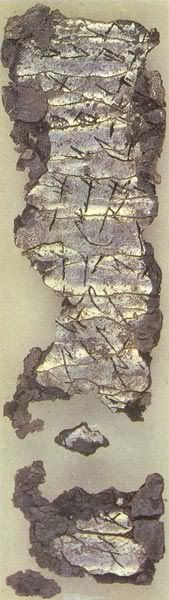
Speaking of the Dead Sea Scrolls, those are definite versions of the Hebrew text that are more ancient than any other, and they often disagree with the MT (and many times agree with the LXX). And don't try to bring arguments about sectarian bias. Most of the Biblical manuscripts at Qumran pre-date the sect itself, and there are very few signs of any sort of sectarian interpolation in those manuscripts. Indeed the very most ancient Biblical texts, those two micro inscriptions found in burial caves at Ketef Hinnom, dated to the seventh century B.C., differ VASTLY from the traditional Hebrew text. They are so early, however, that I question whether the people who made them and used them even thought about any kind of “Bible.” They may just as likely been using something that was repeated with various forms by the priests at the Jerusalem Temple, and were not trying to use a biblical text per-se. That isn't to say that there wasn't some kind of sacred scripture at the time, just that I'm not sure the maker of the scrolls would be any more concerned with it than with the daily rites at the temple.
Aside from those two inscriptions, however, I do think the MT represents the most ancient base texts, older than those at Qumran or reconstructed from the LXX. The Hebrew spelling of the MT is characteristic of the Persian period, as where the spelling at Qumran is from the Hellenistic period. This means that the tradition adopted by the Masoretes reflects an earlier form of consonantal text.
Yes, now is the time to do the double take. The spelling conventions of the MT date to the Persian period. In the first temple period, they only used mater lexiones (consonants that represent vowels... it's complicated...) at the end of words. Assuming there were written Hebrew traditions prior to the first temple period (and assuming that they would have used an alphabetic rather than sylabic scripts), it is doubtful that they would have used any mater lexiones at all (no other alphabetic writing systems of that period do so). In any case, it is nearly inconceivable that whatever traditions we have preserved reflect the spelling of anything prior to the exile. Indeed, the farther back one goes, the less precise it seems scribes cared to be. This is somewhat troubling when it comes to a text with the antiquity of the Hebrew Bible, especially when our earliest manuscripts are many hundreds of years after the original.
Of course, for Josh, I imagine the Torah is of particular concern. We may be very thankful that in all of the various versions, the Torah is the most well established textually. The variants there are not so many or so difficult. The variants in spelling between the DSS and the MT are still everywhere, but the assumed reading is hardly different (indeed, the additional Mater Lexiones in the DSS often confirm a masoretic vocalization that would not be apparent from the consonants of the MT alone). The Torah appears to have been transmitted by all involved with the utmost care as far back as our manuscripts allow us to see (except for some very obvious interpolations by the Samaritans, but even they have been very careful overall). There are still problems, but they are not too bad.

Saturday, February 13, 2010

The Septuagint and Hebrew textual criticism

I'm known among my classmates as someone with a fondness for the Septuagint (the Ancient Greek translation of the the Hebrew bible; LXX for short). The Septuagint is the earliest surviving translation of the Hebrew Bible into any other language.* I have an Orthodox Jewish friend who is quite partial to the traditional Hebrew text, as one might imagine (not that I don't like it). This friend, Josh, is always asking where anyone would get the idea that the LXX is more authoritative that the traditional Hebrew text. Unfortunately, there has never been the adequate time to explain the issues involved, but I do better in writing than talking anyway.
It is to be said from that start, that it very much depends upon what means by “authoritative.” In such a situation, I hardly feel that it's my place to tell to a Jew what is authoritative for his system of belief. Orthodox Judaism holds the Masoretic Text (MT) as the authoritative version of the Bible for their religion (to simplify the story), and I'm not going to argue that they should do anything different (I might argue that they should believe Jesus is the Messiah, but one thing at a time, I guess). 
The question is first and foremost a matter of textual criticism. The problem is that no two biblical manuscripts (prior to the invention of the printing press) say exactly the same thing. Now, in both Old and New Testaments respectively, there is a family of texts to which the vast majority of manuscripts conform, but all of those manuscripts are later than might be desired. In the case of the New Testament, most scholars think that those manuscripts do not best represent the original text, as most of the very earliest manuscripts are somewhat different, and for various reasons, a certain family of ancient manuscripts appear to be the most accurate. Luckly, in the New Testament, we have thousands of manuscripts, many of which are very ancient. Though we can never be sure what the original text was, we have witnesses for most documents quite near to the time of their composition.
For the Hebrew Bible, the traditional text is generally thought to represent the most ancient form of the text. Unfortunately, the earliest of these texts are from the eighth century C.E. The group who produced this text, known as the Masoretes, I would consider to be the greatest scribes who every lived. They took the best Hebrew manuscripts of their time, compared with some of the others, added notes about where vocalization differed from the consonantal texts. They counted words, the counted letters, they counted everything. They invented the system of Hebrew vowels that is still used today (for which first year Hebrew students might hate them). They produced excellent manuscripts, and with an accuracy has never been matched before or after. After doing the world such a great service, they did us almost an equal disservice; the destroyed nearly every Hebrew manuscript prior to their work, locking the Hebrew tradition down to a single family. We don't know what manuscripts they used, and more importantly, we don't know which manuscripts they rejected.
Now, the Masoretes are not wholly to be blamed for this. The Romans, much earlier, had destroyed any documents they found in Hebrew. They also, doubtless, bereft posterity of many Biblical manuscripts, not to mention other interesting documents that would have shed light on second temple Judaism, and probably even earlier times. The Dead Sea Scrolls are, as far as I know, the only substantial Hebrew documents to be preserved from the second temple period. There may be a few others, but they are not so important (or I am very ignorant, which is also possible [remembered later that there has been some good stuff discovered at Masada]). At any rate, they certainly are the oldest biblical texts ever discovered (with the exception of two tiny inscriptions on silver scrolls discovered my one of my teachers a few miles off from where I now sit). Unfortunately, most of the Biblical texts at Qumran are so fragmentary that they are of little use for tracing the history of the text. However, we do have complete witnesses to Isaiah and Habakkuk there, and there are sometimes interesting things to be found in the fragments as well. They are just swell.
However, there are other sources of knowledge about the state of the text in ancient times, and those are the ancient translations. The foremost, as already mentioned, is the Greek, the LXX. The translation of the Torah was in the late third or early second century B.C., and all of the books were probably finished in some kind of fixed form by the middle of the first century B.C., as they appear to have been in wide use throughout the Roman empire by the end of the first century C.E. Naturally, this was a purely Jewish translation, as Jesus wasn't yet born. In the Torah, it is a fairly literal rendering of the Hebrew, and in other books, the style varies, from wooden literalism, to very free idiomatic translation and even paraphrase. The best and some of the earliest manuscripts we have are from the third century C.E., the famous Sinaiticus (א) and Vaticanus (B), produced by the Alexandrian scribal school. Very luckily, this is considered among the best scribal schools of antiquity, and it is also the city where the LXX was originally produced. These manuscripts, though they probably have some corruptions, give a fairly good representation of the original form of the LXX (not that all sections are free from difficulty). Both Jewish and Christian scribes were involved in their transmission, though the Jews had recently rejected the LXX translation, and began sticking more closely to their own Hebrew and Aramaic translations, as well as a new, extremely literal, Greek translation made by one Aquila.
Speaking of Aramaic translations, known as targums, they probably existed orally for a very long time, since the time of Ezra at least, becoming ever more fixed in form, and were written down around the second or third century C.E. Our earliest manuscripts are from the sixth century, as far as I recall. The Targums are fond of paraphrase, and will occasionally add an explanatory note here or there directly into the text. It has also been updated over time to conform more closely to the traditional Jewish interpretation of the Hebrew text. We have much earlier fragmentary targums from Qumran, but they have a lot of differences from the major targums used today, illustrating that this was a somewhat fluid tradition in early times, controlled by the interpretation of the Hebrew.
Though with both the Greek and Aramaic versions, the texts we have are later than one might want, since they are copies of a more ancient translation, they take on a totally different life than the tradition from which they were made. All of the traditions inevitably take on changes as they are passed from hand to hand, but they take on different changes. What this means is that, amongst all of them, we can come closer to what the original version may have been. The more we have, the better.
There are a few other ancient versions of note: The Samaritan Pentateuch. We don't know when the Samaritans first had their distinctive version of the Torah. They claim they have had it since it came from Sinai, and the Jews changed it. However, their text, as far as I know, has more traces of sectarian bias. I haven't done the study myself. It is undoubtedly quite ancient, and should at least be consulted when working on the Hebrew text. The Samaritan communities here in Israel have recently developed a system of vocalization for their text in this past generation. Before that, all of the vowels were transmitted orally. Unfortunately, these texts are very expensive to buy. The first English translation of it with commentary is now at the presses. One of my classmates was involved in the editorial process.
Also to be mentioned are the Latin and Syriac versions, the earliest Christian translations. The Old Latin versions were, unfortunately, based on the Septuagint, and serve us much better to illuminate the history of that text than the Hebrew. The Syriac version his also heavily based on the LXX, but it seems to be conferring with a Hebrew text as well. It must be used very carefully. The later Latin Version, the first commissioned by the church, is Jerome's Vulgate from the end of the fourth century, a translation directly from the Hebrew. It is, overall, a good translation. It appears to represent a Hebrew tradition very closely related to the the traditional version still used in Synagogues today (which makes the divergences even more interesting).
Now, when dealing with all of this evidence there are several things to take into consideration. The translations are very interesting in and of themselves, as they very much represent the theologies and interpretations of the communities that created them (this, perhaps, is where my love for the LXX is really founded. It shows us how Jews were reading the Bible in pre-Christian times). However, if one is simply inquiring as to history of the Hebrew text, One must be very careful how they evaluate the evidence. There are many cases of explanatory words and phrases being added by the translators, and one must be aware of such things. In additions, there can be changes which are clearly scribal errors in the receiving languages. What is most interesting are cases that reveal scribal changes and errors in the Hebrew.
There are cases where the Masoretic text (MT) is very difficult to understand, and the LXX says something totally different. When this happens, one attempts to reconstruct the Hebrew underlying LXX. Sometimes, is seems clear that the translators simply changed the meaning so it would make sense, or a Hebrew scribe added a word (a much more rare occurrence). Other times, you will find that it is the difference of a single Hebrew letter, and when that is amended, the MT makes perfect sense. These are the kinds of the things the textual critic is looking for. There are even times when you find that the meaning is totally different, but the reconstructed Hebrew text is identical. It is only the Vowels that are different. This is even more interesting, since the vowels were only written down in the time of the Masoretes. However, occasionally, the LXX, Targum, or the Latin version will attests a different tradition of vocalization. It is often up to the textual critic to decide which of these vocalizations makes more sense in context, and there are few objective criteria to be used (aside from conventions of Biblical Hebrew orthography, which themselves are hotly debated).
However, I must impress that, overall, there is great unity among the various textual traditions, and the stand as a testament to the good work of the Masoretes and their predecessors. There are some exceptions. Jeremiah and Samuel are huge problems textually. The Psalms are also not great. Still, the messages of these books are not greatly changed by such problems.
This further raises questions about which form of text any particular community should be exegeting. To that, I don't have an answer. Catholics have the Latin versions and the Canons for interpretation, Eastern Orthodox have the Byzantine text of the LXX. Orthodox Jews have the MT and the Midrashim as a source of authority. As protestants, we say that we are trying to reconstruct the original text. However, most of the books of the Old Testament (in contrast to those of the New), went through extremely long periods of editorial process, and it is difficult to say which text is then the “original.” In some books, it seems there are textual witnesses from before the completion of a large part of the editorial work (such as Jeremiah). On the other hand, even the MT represents, in a way, a final phase of editorial and interpretative decisions (as do all translations, ancient and modern). As a student of scripture, this is a fascinating process. As a Christian who goes to scripture as a source of authority, I must admit it causes some perplexity, and leaves me in search of paradigms for inspiration and authority that do justice to the complexity of the text we have. That question, I must leave for others until a later time. I certainly don't have an answer at the moment, and theology isn't exactly my strong suit. Reading the Bible tends to mess up one's theology.


*With the possible exception of some fragmentary Aramaic versions from Qumran, which may be contemporary.


P.S. Having recently read some things by Prof. Emmanuel Tov, this post seems so yucky and inadequate. I really need to look more into OT textual criticism. 8^(

Wednesday, January 13, 2010

Anyway, about that blog list...

That list I got on to two posts back... they decided to stop doing it.

I'm not on any list anymore, particularly not right next to Ben Witherington III. Oh well. *sigh*

Friday, January 1, 2010

Synoptic Gospels: My Theory...

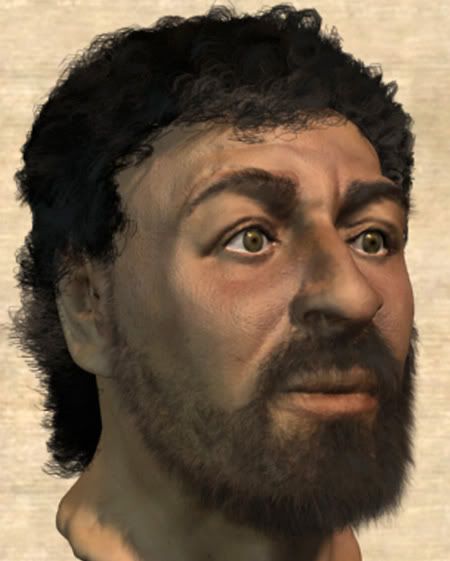
That weird BBC reconstruction of Jesus' head.

The in post before the last, I talked a bit about oral tradition, Hebrew Matthew as an early collection of this oral tradition, and the development of Greek oral tradition as the Gospel moved into new contexts. Mark would then represent a written form of this phenomenon. This was not just any tradition, but, if the father's are to be believed, it was selections from the preaching of Peter masterfully arranged into a complete narrative, a document quite unlike Hebrew Matthew, which, I suggest, was a collections of sayings arranged topically, perhaps occasionally placed in a narrative context.

Now, the publication of Mark's Gospel would have had a great effect on the Greek Oral tradition, causing it to become much more stable in the communities where it was promulgated. Still, Mark's Greek isn't particularly good, it seems that native speakers often felt a need to correct him in the retelling of the same traditions, not to mention that independent oral traditions in Greek must have already existed, and probably also had an influence on the retelling of Mark. I'll get into evidence of this in a few paragraphs here. Let's get on to my favorite gospel now, Luke.

I like Luke because he approached the writing of his Gospel in the same way that I would have. He got as much evidence in front as he could, and tries to present it as accurately as possible. He seems to be a product of Hellenistic culture, and therefore shares many of the concerns that other western historiographers might. That's not to say he doesn't have an ideological agenda. It is to say that all historiographers have agendas. However, Western historiographers operate under the assumption that their argument will have the most force if it is grounded in verifiable facts. It appears to me, and to most others, that Luke knew the Gospel of Mark in some form, and possibly knew the man, John Mark, as well, if the traditional ascriptions of authorship are true. Luke follows Mark's chronology very closely (up until the passion narrative, where he prefers a different order) but he polishes up Mark's Greek.

Furthermore, it appears that he also had a Hebrew or Aramaic source in front of him, because he's often translating it very literally, and we can see the semitic syntax, especially in the sayings. Let's go ahead and call that Hebrew Matthew. But Luke was probably working with other semitic sources as well. One of those sources, again following the traditional view on authorship, would have been Paul, and whatever strain of Hebrew/Aramaic oral tradition was current in Pauline circles. From the first couple verses of Luke, it also seems very possible that he sought out eyewitnesses and used them as another source. He has no qualms about going against Mark's report when he believes he's got a better tradition, and he prefers almost always to make his own literal translations of semitic sources. It is also important to note that he did not attempt to fully preserve any of his sources, but to use all of them to create the narrative he wanted to create. Because Luke was came out a bit later and didn't follow any previous form of the Greek oral tradition, Mark continued to be more often quote for its familiarity, though sometimes in a polished form. Luke's main influence on the oral tradition was in the areas where Mark had not written, and this was still not so profound.

Some time later after the Greek oral tradition had really begun to crystallize, some anonymous saint came along and decided it would be worthwhile to preserve Hebrew Matthew in Greek (for which I am very grateful, being that it is lost in the original, unless there are bits of it preserved in Shem Tob's Hebrew edition of Matthew, a topic I'm not going to touch now). However, this wasn't all he did. He retained the structure of Hebrew Matthew for the sayings, but supplemented by Mark's narrative in polished Greek. In the sayings, he likes to follow Mark very closely where he can, sometimes fixing the Greek according the oral tradition. In other places, he follows, I think, different forms of the Greek oral tradition, which is sometimes influenced by Luke's translations of the content of Hebrew Matthew (and thence the so-called Q), and sometimes takes another form. Occasionally, he makes his own original translations, which, like Luke's, tend to be quite literal. It appears that this writer believed the Greek oral tradition to be authoritative, which is consistent with what we know of the early second-century fathers.

Because Matthew relied so heavily on the established Greek oral tradition for its wording, it was immediately popular in the church for its familiar sound, and quickly became the most quoted gospel (though I must admit, it may have gone the other way around, and it only seems that Matthew is quoted so often because he used the authoritative Greek oral tradition. It probably worked both ways, in reality), and was naturally placed first when it came time to order the Canon. Even today, The sayings of Jesus are most often recalled according to the Greek version of Matthew.

So finally, we are left today with Mark, a crude translation of Peter's version of the oral tradition, masterfully arranged into a thrilling historical narrative of a very eastern kind, Luke, the "historical-critical" Gospel, and Matthew, our only glimpse of Hebrew Matthew, and the preservation of the Greek oral tradition promulgated in early second century church. Course, we also have John, but that's something else. I don't even know where to begin with John.

(For those who want to know, I think the Western textual tradition of the gospels also preserves a lot of elements of the Greek oral tradition that are not found in the canonical Gospels. If this could be proven, their value in study of the historical Jesus would go up tremendously. Unfortunately, I don't have time to do this myself, working on an MA in OT at the moment. Perhaps one of you working on a graduate degree in New Testament could make a good project out of the Western text, seeing where it represents scribal corruptions of the original, and where it appears to represent a separate oral tradition. This topic could easily be a doctoral dissertation.)

Thursday, December 31, 2009

NO!! I'M IN THE BLOGOSPHERE!!


Hey everyone, I've been drowning in work here, but I love it. My teachers are excellent, and my classes interesting (at the Hebrew U of Jerusalem, for those who don't know). Whenever I get a free moment, I will have TONS of stuff to blog about, Old Testament style.

I hope to squeeze out another post about the Synoptics tomorrow, if I can muster the energy for it, and finish up the whole thing about the Gospels by the end of January, so I can shift my focus to what I'm working on now.

Despite the lack of attention I've been giving this blog, it appears to be gaining a flourishing readership. Just found out that I've been listed on Biblioblog Top 50 Website. I'm at 122 right now, for the month of December. Interesting, since I've barely posted anything in the last couple of months. I'm listed in the complete listing under New Testament and Early Christianity, right next to Ben Witherington. Hmm... I feel good about this, and I'm not sure that's a good thing.
Who cares? maybe me a little, but I guess not the readers of my blog. More on the Gospels tomorrow.

Saturday, November 14, 2009

Synoptic Solutions: Oral Tradition

Ok, The reason I started this blog in the first place was actually to get my theory on the compositions Synoptic Gospels out there, but I wanted to spend some time getting a few readers, make the posts a bit episodic so I didn't just drop the whole theory on you all at once, the theory I came up with shortly after finishing my BDiv. A year and a half ago.

Let's make a quick review:

June 7, 2009. I state my difficulties with the typical Q hypothesis; ie: no external evidence exists, but I go on to hint at another kind of Q, Hebrew Matthew.

June 15. I provide a small list of references to Hebrew Matthew found in the Church Fathers, The most interesting being the earliest, Papias, who says that Matthew published the sayings of the Lord in the language of the Hebrews, and that each interpreted them as they were able.

Oct. 9. I explain what kind of a document I think Hebrew Matthew was: similar to other rabbinic collections; the collected wisdom of a great teacher containing mostly sayings, occasionally with bits of narrative material to situate the sayings. In this case, I believe the the material was arranged topically in five sections, those we see reflected in our canonical gospel of Matthew. Of course, this is very tentative, and much more work must be done on the relevant texts before more can be said (and really, this is already too much).

So, let's begin to paint the historical portrait:

Jesus teaches his disciples and the crowds. This is the beginning of what we call the oral tradition. In an Eastern context, a great teacher teaches and says many of the same things over and over again, and people memorize it. Of course, his close followers will get the inside scoop on his total world-view simply by being with him, seeing how he lives and how he thinks. In all of the Synoptic gospel account we have Jesus, at one point or another (or more than once), sending out disciples to proclaim his message. We must assume that the core of Jesus' early message had begun to crystallize into distinct oral forms within his lifetime if he was already sending out his followers to preach it. This oral tradition must have been in Hebrew or Aramaic or both.*

Certainly shortly after his death, oral forms of the sayings would have been quite fixed. This represents the earliest forms of the sayings material in the Gospels. In the transmission of such material in an Eastern culture, there are also sometimes narratives, but the narrative material is not as closely controlled by the community as the sayings. This may be a partial explanation to why he have such close affinities in all the sayings material, and less continuity in the Gospel narratives (though they are obviously also in close relation).

I think Hebrew Matthew must have contained a direct record of these original sayings, probably composed in Hebrew, rather than Aramaic, if my intuition is correct. I don't want to make any bones about it at this point in my research, however (not to mention that my personal grasp of Aramaic is still in its infancy).

After the dispersion of the Apostles, at the beginning of the spread of the Gospels in the wider Roman world, the early preachers and teachers necessarily began to translate Jesus' teachings into Greek. The Greek oral tradition would necessarily be more free in early stages, but would still be controlled by the rigid underlying semitic tradition. Still, different forms of the sayings would have developed in different regions. There's more than one way to translate anything. That's just how it is.

Mark is probably our earliest example of this. I will accept the testimony of the early Church that Mark is a collected narrative based on Peter's preaching until I find a good reason not to do so. He probably wrote around the time of Peter's death in 64 AD, but who really knows? However, Mark is much more than a mere translation and recording of the primitive oral tradition. It contains eyewitness narratives. In addition, the arrangement of the material is a unique work of art, creating a narrative super-structure that is at once both cryptic and enticing. I can't get too heavily into this discussion, as I'm still something of a neophyte (aka: n00b) in Markan studies.

However, what I will say is that the publication of a Gospel in Greek must have had a tremendous impact on the stabilization of the Greek Oral tradition.

That's all I'm saying for now. Next post will deal with my theory on the composition of Luke and Matthew.


* Note concerning language: According both to the Mishnah and Josephus, all Jewish boys learned to read speak some level of Hebrew from the age of six onward. It is often said that Hebrew was the language of literature and religious discourse, and Aramaic was the everyday spoken dialect. Well, I'm not sure about that. At Qumran they were writing religious texts in Aramaic as well as Hebrew, and Josephus transliterates some direct speech of the soldiers during his defense of a Galilean outpost, and the soldiers are speaking Hebrew. Some have suggested that Hebrew was still a colloquial language in Galilee, but Aramaic was the language of the street in Judea. I honestly have no idea what language Jesus was teaching in, but probably a bit of both. He certainly would have been able to speak both, and it is not uncommon to find that rabbinic and Qumran texts are very much a sort of hybrid between the two.

In any case, the two languages are not very different, and it is not overly important. Most of the saying can be reconstructed into Hebrew or Aramaic with equal ease, as the syntax of Palestinian Hebrew and Aramaic had almost completely merged by that time, with only a few unique uses of the ancient Hebrew tense system being used for literary effect in an artificial way (very much as you still find some people praying in botched King James English today). The vocabulary in Aramaic and Hebrew is also quite similar, and the primary difference between using one language or the other (at least in Rabbinic writings) was changing some endings, using different roots for a few common words, and putting the article in front or behind the word. It's a bit like the difference between Danish and Swedish, as far as I can reckon (by contrast, pre-exilic Hebrew differs much more from Official Aramaic, the dialect of the Persian Empire)

It is also very possible that Jesus spoke Greek at times to gentiles, though he may have also spoken Aramaic to them. Difficult to say, really.